Wednesday, February 3, 2010

American and Chinese Monetary Policy : a Macro Perspective (1/2)

A (short) but interesting piece by UBS Wealth Management Research comparing the monetary stance of the FED and PBOC.

For years, observers have turned to the ECB to provide them a comparison-basis to judge the FED and its policies. As Europe is likely to undergo an extended period of under-par growth and internal questioning and as China gains momentum on the international scene, attention will turn to the Chinese central banking model and how it fares relatively to its Northern American counterpart.

Comparing China and America is a perilous exercise given the stark differences between both countries. A country of 1.3 billion inhabitants which has undergone in the past 30 years the fastest-paced political and economic streamlining in history cannot fall under the broad definition of being a "capitalist" or "communist" country. 
Moral hazard, defined as governmental intervention to bail out insolvent parties, is often referred to when describing the USA. Not China. There is no Xiaochuan put. What the US spent to save AIG, the Chinese government used to build infrastructures. 
In the 1980's, benefiting from the opening up of the local market, western banks started settling in China and making a series of bad loans to local entities. They took for granted the Chinese government would step in and prevent national companies from failing. It didn't.

As embodied by chairman Bernanke's reelection, trying and failing is accepted, if not rewarded, in the US. In China, accountability of governmental institutions is the first pillar of social rest. In China, the Party cannot fail. It has to "cross the river by feeling the stones(1)".


How monetary policy is considered, channeled and judged is highly impacted by these divergent mantras.

  • Correlated Quantitative Easing, Mixed Results


Bernanke had announced(2) he would fight deflation at all costs, referring to Milton Friedman's "helicopter drop" of money. The least is to say he held tight to his principles, adding $813 billion to the FED's balance sheet in the 5 months to August 2008.

With hindsight, it seems that decoupling presented to heavy an opportunity cost for China and its government. Lacking internal demand and economic knowhow, China had to make do with the US, and reciprocally. Even today, it is hard to say where the USD would stand if the renminbi peg had not be resumed in mid 2008, triggering in the process a rally in the greenback.

Whether it was targeted at sustaining national economic growth, limiting the downside risk on its trade account, or maintaining the renminbi/USD peg, China correlated its monetary stance to its western counterpart's. Monetary mass expanded y-o-y by 32% in China, leaving the country awash with liquidity.
Chimerica had committed to quantitative easing.

Confidence is the backbone of monetary policy efficiency. Without confidence, monetary expansion boils down to pushing on a string. 
On the one hand, the FED's credibility had been eroded in the wake of the IT bubble with the so called Greenspan Put. On the other hand, People's Bank of China is ran by the Chinese government which, contrarily to the prevalent opinion among China bears, is supported by its people.
In the US, banks witnessed how market speculation had triggered a run on Bear Stearns, and fear grew they were exposed to similar margin call risks. In China, People's Bank of China has a significant stake in local banks and is hence capable of influencing their policy.
This diverse drivers resulted in similar quantitative easing policies being channeled in deeply divergent ways, and thus entailing different outcomes.


  • Where did the money go?
As a major share of their assets were valued according to mark-to-market standards, fading confidence resulted in a rapid downsizing of American banks' balance sheets. Relying on risk models based on the erroneous assumption of normally distributed returns, banks were caught off-guard. Being granted almost overnight a "free lunch" by the FED's  easy money, they used the freshly printed dollars to increase their reserves and thus hedge their margin call risk exposure.

The central bank is entitled to supply aggregate reserves. The FED did so by expanding its balance sheet to record levels. However, it is the bank's role to supply end money (currency in circulation). It is their behavior which drives the deposit expansion multiplier. Designating the incremental money in circulation for each dollar added to the monetary base, the money multiplier is correlated to the banks' willingness to lend. 


When the crisis peaked and confidence dropped, the deposit expansion multiplier plummeted.


A situation both visible in M1...:


...and in M2:


As a result, M2 increased by $538 billion when the FED's balance sheet had expanded by $813 billion, a 40% difference. Bernanke succeeded in what he thought central bankers had did wrong during the Great Depression of 1931: printing sufficient money to maintain M2 expansion. History has taught central bankers a major lesson : when confidence plunges, base money supply is a poor indicator of money in circulation and thus of market liquidity.


The banks' reluctance to lend prevented the FED's expansionary monetary policy from kick starting the real economy. However, the excess money was channeled by institutional investors to financial markets and ignited an asset reflation-led recovery.


China offers a brighter picture of monetary policy effectiveness, local banks having lent accordingly to the PBOC's centrally planned and directive policies. 


1 is the money multiplier threshold. Above 1, growth in the money supply exceeds base money growth. Under 1, the outcome is the opposite. Since 2007, M2 growth in China has outpaced GDP growth, implying a money multiplier >1.
Less leveraged and more state-driven than their western counterparts, Chinese banks succeeded in providing the necessary liquidity to both the real and financial domestic markets, hence maintaining annual real GDP growth >5%.


During the 4th quarter of 2008, the PBOC started by pausing its emission of central bank bills in the exchange market (sales that were aimed at offsetting upside tensions on the RMB created by the trade and capital account surpluses). 


It is also worth noting that the financial environment was different before the financial crisis in China and the US, thus resulting in divergent monetary policy outcomes.
China had taken advantage of its above par expansion pace to streamline its banking system through massive capital injections and non-performing loans write-offs. The dramatic increase in liquidity in the inter-bank money market has thus spurred a rapid increase in bank credit and broad money supply.


Part 2: Money Never Sleeps, Inflation outlook in the US and China


(1) “Crossing the River by Feeling Each Stone” refers to the pragmatic policy of Deng Xiaoping, to move ahead with economic reforms slowly and pragmatically.


American and Chinese Monetary Policy

Tuesday, January 12, 2010

Moral Hazard and the Corporate fixed income market

As shown by this chart (courtesy of Zero Hedge), European sovereign spreads measured by the Markit iTraxx SovX Western Europe Index have risen higher than corporate iTraxx indexes for the first time in history, reflecting growing fears of a sovereign default tail risk in 2010.


First, the analysis requires mentioning that the geographical composition of both indexes differs.
As described by Markit, the SovX indexes include:


  • Markit iTraxx SovX G7 – tracking the credit risk of the most industrialised countries in the world.
  • Markit iTraxx SovX Global Liquid IG – tracking the credit risk of countries in Asia Pacific, Eastern Europe, Latin America, Middle East & Africa, North America and Western Europe.
  • Markit iTraxx SovX Western Europe – tracking the credit risk of 15 countries in Western Europe.
  • Markit iTraxx SovX CEEMEA – tracking the credit risk of 15 countries in the CEEMEA region.

If the breakdown of the corporate index is not disclosed, the inversion of the curve would not be witnessed were both indices to be trade-weighted in the same way.


Second, the limited lifespan of the European SovX index must be discounted, the index having been opened to trading only since September 2008.


However, the spread between the Sovx and Corporate indexes stands at a record-low level and even turns negative without the geographical distinction.
On the one hand, debt-laden governments face increasing doubts from investors regarding their ability to fund both previous and upcoming fiscal stimuli. We distinguish two premia drivers depending on country monetary independence:

  • Fiat currency countries: Being able to use quantitative easing strategies to inflate out of their debt, there is low tail risk these countries will default. In these countries, spreads are driven primarily by inflation expectations.  
  • Countries with no/low monetary indepence: as it is the case for Greece, increasing CDS spread are driven by default risk perceptions. 
On the other hand, corporate spreads are driven lower by develeraging and a global improvement in corporate cash flow generation. There is little doubt investors also consider central bank interventions will be led were corporate default risk to appear. The sheer definition of moral hazard.


As a result of these trends, credit default swaps spreads between European sovereigns (equally weighted) and the European investment grade credit universe have significantly tightened.


This news comes as corporate bonds issuance and subscriptions reach record levels, suggesting that Q1 2010 could provide credit markets with a 2009-type windfall.
On the sovereign side, the yield curve between 10y and 2y has reached the 288 basis point record mark, reflecting growing anticipation the FED will hike rates sooner than expected.


Were central banks to move towards interest rate raising, the trend on corporate bonds yield will reverse as bond price go down. As seen on the chart, the corporate itraxx has retraced its Lehman related increase and has been range bound during the last 2 months.


As the spread between government bonds and high investment grade corporate bonds closes to 0, investors will increasingly shift to riskier positions.


Monday, January 11, 2010

The Currency Issue

A new year, and most importantly a new decade. Investors place great hope in 2010 as a turning point, as if the year could provide them with a new starting point.


As the subprime scheme unraveled and triggered a global credit crisis, hopes placed in the 21st century as the new moderation era have vanished. Whether it stems from IT-driven business models, ever increasing house prices or global decoupling mythes; one lesson we shall keep in mind is that mean reversion is the norm and genuine paradigm shift the exception.


Throughout the unraveling of the housing and credit bubbles, governments have globally put to extensive work their currency printing press. For this reason, at least, currencies are bound to play a center role in the development of the global economy.


Hence, as a reminder to myself more than as a attempt to forecasts random macro upheavals that could occur in this new year, I here list some key developments we could witness. None of them are time bound, and all of them are imagination driven.

  • As directional risk in global portfolios increased due to growing asset correlation, currencies' role as an independent asset class will rise. In the era of uncertainty, investors seeking liquidity and transparency will certainly allocate a growing share of their portfolio to currencies. Currency-based portfolio diversification should gain further momentum due to the increasing attention given to ETF vehicles.


Active currency in portfolios is used in two primary ways. Either via an active overlay to a plan's international exposures or by taking on currency as a separate or alternative asset class … However for all intents and purposes, active currency has zero correlation to the major equity and fixed income asset classes. … In the search to add non-correlated series to achieve diversified returns, active currency can play a significant role. KATHY MANN, Currency as an asset class

  • As sovereign-credit fear rises in 2010, the prices of the dollar and the euro will be increasingly driven by country risk exposure. Were fears to grow on one of the country's economic partners, the dollar will likely overshoot to the downside. 
    • In this scenario, Greece and Ukraine could  represent a significant downside tail risk for the euro, and trigger a rally in the dollar. This could further delay the awaited renminbi depeg.
  • As the mix between short-term and long-term unemployment becomes increasingly skewed towards the latter in developed countries, social resentment will feed a new wave of political backfire against currency manipulation. Due to the its comparatively low labor cost base and its growing role in the global economy, pressure will likely mount on China to revalue. 
    • China is certainly to keep its peg until the 27% increase in the dollar value that occurred between July 2008 (when the Renminbi peg was reimplemented) and November 2008 is fully retraced.
    • There is little doubt the Chinese moderation principle will once again be applied to the renminbi revaluation. Fragility in the banking sector, doubts on probable government-led price distortion and record monetary expansion (+32% year on year) are too significant bulwarks to a free floating yuan to be ignored.

  • Recent political developments in Japan and associated moves in the yen relatively to other major currencies suggest political announcements will be a major driver for the currency. Two lost economic decades and the country's remote location from the economic Asia-Pacific zone are major impediments to a short-term growth resumption. 
  • National policies in Japan will focus more importantly on internal macro tweaking. As a result, and until a renminbi detachment provides investors with a third major currency position, the correlation between the euro and the dollar should further its way to -1.
    • As it hovers around 1.5, the euro/dollar (EURUSD=X) still stands 7% short of its July 2008 level when the Renmibi peg was made reeffective. Hence, a Chinese revaluation in the short-term could send the euro above the 1.60 mark against the euro. 

  • Governments relying on highly price elastic goods and services or/and willing to inflate their way out of debt could engage a 21st-century "beg my neighbor" global policy.
    • As governments pursue their asset reflation policies, greater currency debasement is expectable. In the short-term, chances are these policies will be equivalent to "pulling on a string" as long as credit creation remains in negative territory. Were lending and confidence, its compulsory counterpart, to resume, higher inflation will feed in the real economy thus increasing the macro-risks pending.

    As noted in JP Morgan's 2010 EMEA Outlook:
    Currency markets do not meet the usual criteria for bubbles –extreme valuation, momentum and leverage.
    In the risk averse environment we trade in, this could prove to be the most important driver to the FX market.

    Wednesday, December 2, 2009

    Would a fly to safety benefit the US dollar?


    For people who still believe in a strong dollar, there is little doubt Dubai's announce that it could default on its debt was a positive Black Swan event.

    1) It was rather unpredicted: Amid the annoucement,
     the Nikkei 225 lost 3.2 percent (its biggest one-day decline in almost eight months), the Korean Kospi fell 4.7 percent (a four-month low) Australia's S&P/ASX 200 lost 2.9 percent and Hong Kong's Hang Seng dropped 5.1 percent to 21,088.55

    2) It involves systemic risks and could turn out to be the tipping point that brings us to descend the second slope of the crisis.

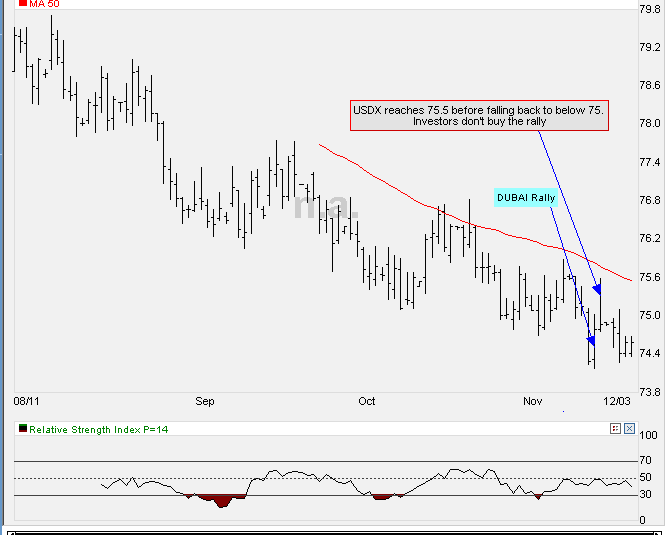
    3)It triggered a (short-term) rally to the dollar, at a moment when Greenbak futures were plummetting an the dollar trade index continuing its slide.

    Though, this rally was short lived, as shown below.


    What we should apparently learn from this mini dollar rally is that even if Treasury debt was multiplied by 24 from US$0.5 Trillion to $12 Trillion and the US dollar Index  (NYBOT US$)  lost more than 16% since last March; 
    the fly to safety argument holds firm.
    The fact that the financial community continues to lend back to the government QE money by buying T-bonds even in negative rates territory is another argument supporting the "safe heaven" greenback t(h)e(rr)orists.

    Now, let's face the other aspect of the Dubai events: the possibility of living the infamous "double dip" because of a sovereign debt crisis.

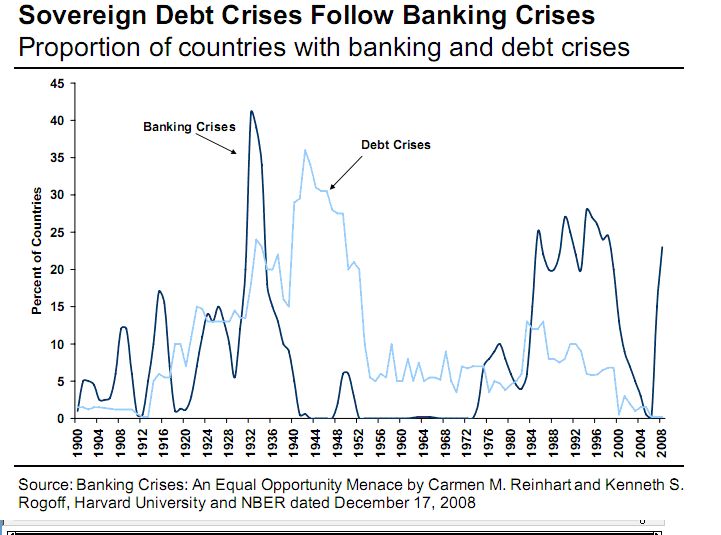
    As shown by the following chart (courtesy of Morgan Stanley), the Great Depression (the only crisis comparable in direness to the one we are experiencing) was prolonged by a sovereign debt crisis.


    As visible in the rise of CDS spreads, premiums are already integrating sovereign debt risks concerns.

    Currently, financial institutions are comparable to boxers going entering a new round after getting beaten up in the last one, still dizzy from the uppercut received before the bell but feeling better after the medics applied soothing balm on their wounds. At this point in the fight, a slight hit from the opponent in a sweet spot  would pave the way to knock out.

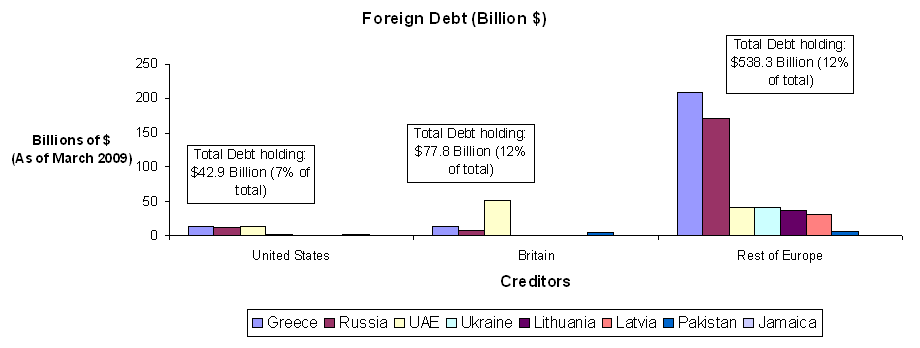
    As measured by debt holding of countries with high sovereign defaulting risks, the US' exposure is less important than Europe's one, feeding bullish sentiment towards the dollar.


    However, before jumping to the conclusion that the dollar will rally would Ukraine; Greece or Ireland announce they default there is at least one other aspect we should consider:  governments, worlwide, seem utterly concerned by monetary policy and a "currency war" scenario should not be banned. The unwinding of the QE fed carry trade bears too heavy a political brunt to happen in an orderly fashion.

    If the plumetting dollar is considered as a major issue in Japan and Europe, the impacts of an unwinding of the dollar carry trade cannot be reduced to these countries alone.

    The St Louis FED establishes two trade dollar weighted indexes : USD/Major Currencies; USD/Broad
    As defined by its statements:


    Broad currency index includes the Euro Area, Canada, Japan, Mexico, China, United Kingdom, Taiwan, Korea, Singapore, Hong Kong, Malaysia, Brazil, Switzerland, Thailand, Philippines, Australia, Indonesia, India, Israel, Saudi Arabia, Russia, Sweden, Argentina, Venezuela, Chile and Colombia.

    Major currencies index includes the Euro Area, Canada, Japan, United Kingdom, Switzerland, Australia, and Sweden
    Emphasis mine. Bold shows countries present in both lists, I will call them "Emerging Currencies" from now on.
    A quick glance shows us that from the countries included only in the "broad" index, none is European.
    Japan and the Euro area are both included in the Major Currency Index.

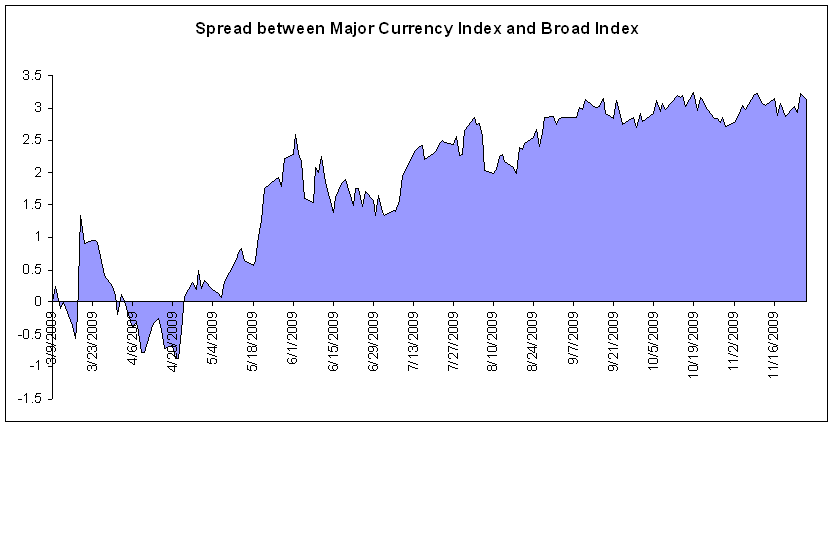
    When diversification from the dollar is the trend, "emerging currencies" appreciate faster against the dollar than "Major Currencies"."Fly to safety" events erase those gains meaning they follow the same evolution to the dollar than "major Currencies". This describes the situation that occured since the beggining of the crisis:


    "Fly to safety" logic relies on a risk/reward tradeoff hypothesis.

    The dollar rally ignited in q4 2008 occured mostly because fears of systemic risk pushed investors to short their holdings in both "major" and "Emerging" Currencies and go long the Dollar.
    Fear that we would live another Argentina-style debt default domino effect or a repeat of Q4 08 volatility is turning out to push the dollar safe-heaven status to the point it masks US fundamentals.

    As of today, we have no real clue as of if a sovereign debt crisis will be contained to 2nd rank European and Middle Eastern Countries or cause a systemic shake in the global economy.

    On the other hand, since the trade weighted USD index peaked on March 9th this year at 115.094 (Major Currencies Index), most of the diversification strategy has been directed towards "Emerging Currencies" (which, as seen before, do not include European Countries).


    From this situation, two conclusions arise:

    - With Greece, Ukraine or Iceland at the first stage the epicenter of the sovereign debt crisis seems Euro-centered. Since most of the diversification away from the dollar has been directed towards non European economies, were a dollar rally to take place in the short term it should be rather moderate. In the long-term, we have too few insights at the moment to exclude another "fly to safety"

    - Omitted this far, we cannot be blind to how gold is considered as a new hedge by investors. A dollar rally scenario relies on the fact that the greenback would continue to be considered as the only "safe heaven". Since Oct 2007, fly to safety benefitted the USD but also gold, Treasuries and German bunds. Gold, above all, has tracked the major events in the Credit crisis, respectively spiking and relieving in recessions and improvements.
    In the case a global sovereign debt crisis occurs, laying bare the nocuous effects of the fiat currency printing policy, there is little doubt the dollar would be the naked king.


    Saturday, November 28, 2009

    Confidence: What Google has to tell us

    Throughout my reading of the financial news of the last two years, I have come across two main themes again and again:
    -The subprime crisis and its aftermath
    -The rising of Google, possibly the most scrutinized company of our time

    A lot of people agree that the subprime mess stems from the irrational exuberance of markets, which has successively led the markets up, down, and up again.
    The recovery from the March lows may only be due to confidence gaining ground.

    I believe one reason we have trouble understanding and taming these "animal spirits" is reductionism. Can we consider the confidence surveys we follow with great attention to be relevant when they only consider a sample of the population and are limited to a single country? In our complex and interlinked economy, can we consider confidence to have territorial frontiers?

    This is where Google and its worldwide presence comes into play. The ubiquity of the "Don't be evil" company could turn out to provide us with a great tool to assess Global Confidence, a worldwide prediction market without the biases and reductionism of traditional (and costly) surveys.

    A lot of talks has taken place lastly on the different scenarios we should expect.
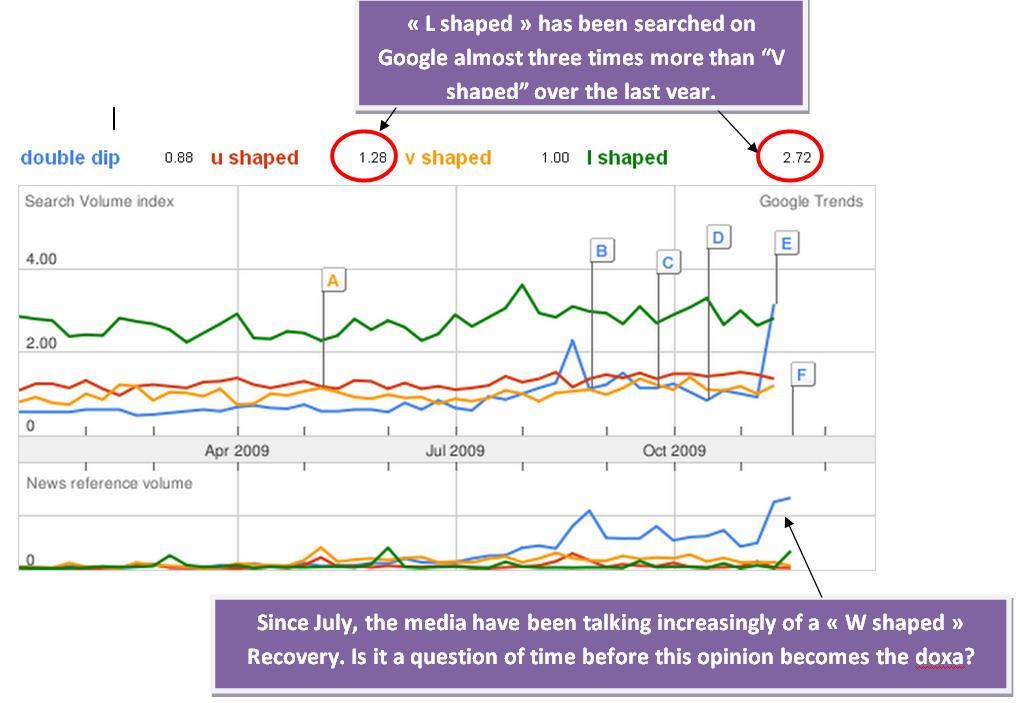
    Google can help us compare, through the search occurrences and apparitions in Google News of the different terms, were we stand.

    Search occurences on Google of the recession Scenarii (index 1 on "V shaped")
    
    Not surprisingly, we observe a good fit between search occurrences and apparition in the news.
    Now, assuming that the search volume index represents the global opinion and News reference volume the experts opinion, the global and experts thinking seem correlated.

    Therefore, the recent increase in news articles mentioning a double dip recession could reach a Tipping Point, moment when the fear of a W shaped recovery could feed in the global opinion and entail a self fulfilling prophecy.

    If, we are truly living a Confidence based recovery, the only thing we have to hope for is hope itself.

    Confidence is also greatly influenced by people that, following Malcom Gladwell's definition, we should define as Mavens.
    Example Investors Figures of these Mavens would include Warren Buffet, Bill Gross, Marc Faber and R.Prechter. These "information specialist are the people that "we rely upon to connect us with new information" and have the capacity to "start word to mouth epidemics".
    Once again, the growing pessimism of these Mavens (Bill Gross' last newsletter expresses fear of Bubbles, for those who missed it) could feed into our global confidence Google Index.

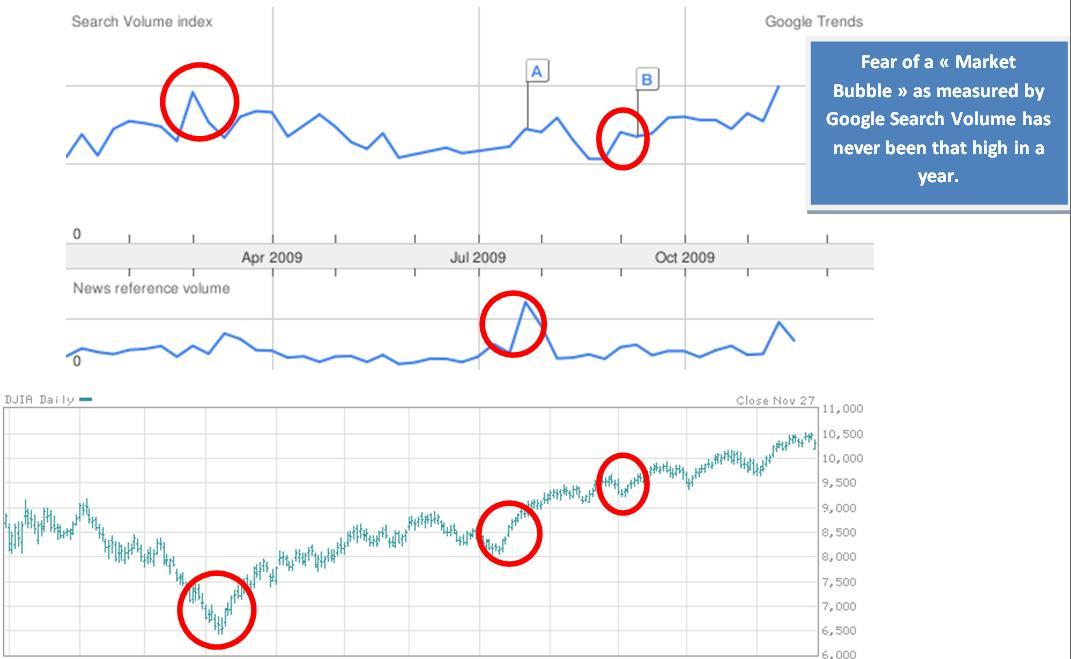
    The Google Search Volume for "Market Bubble" is currently reaching yearly highs.

    Google Search Volume Index for "Market Bubble" 2009


    No Indicator can predict how the markets will react.
    Ironically, Google has been one of the pioneers in implementing a prediction markets for employees to assess variables as the company's future growth, on the assumptions that the higher the employees' confidence, the more they would strive to drive the future growth.

    Google, with its worldwide presence and use, could turn out to be a great tool for trend analysis.
    Maybe Google is the End of the World as we know it, but the picture it has to show us could be the World as we should know it.

    Sunday, November 22, 2009

    La reprise est-elle au coin de la Rue?

    Selon Ben BERNANKE, elle semble l'être.
    Pourtant, peu de signes pointent aujourd'hui vers une sortie de crise rapide. Pour une analyse point par point du gap entre le scénario optimiste de la FED et la réalité des indicateurs, voir ici.
    Peu de personnes remettent en cause le fait que depuis la mi-mars, l'économie mondiale semble avoir retrouve le chemin de la croissance économique. Cependant, encore moins paraissent l'attribuer a une amélioration des fondamentaux.
    Se pencher sur le phénomène d'illusion monétaire offre une piste de compréhension du rally actuel.

    Si il y a une leçon à retenir de la crise des subprimes, c'est que l'ensemble des scénarii possibles est beaucoup plus important que ce que les modèles, voire les individus, peuvent l'imaginer.
    Les systèmes complexes, dont les marchés financiers font partie intégrante, sont caractérisés par des Marches Aléatoires. Le Mouvement Brownien utilisé pour représenter l'évolution des Marchés Financiers, comme son nom ne l'indique pas, est dérivé du mouvement pris par des particules de Pollen dans un liquide.

    Ce phénomène de marche aléatoire rend obligatoire une analyse en termes de Scénarii. Nous devons apprendre à vivre avec, et exploiter, l'improbable.


    “Better prepare for confrontation than hope that the enemy will not come;
    Better ensure one’s defense is impenetrable than hope that the enemy will not attack.” – Sun-Tzu 
    The Art of War 6th Century, B.C.


    Développer plusieurs scénarii permet de développer des stratégies de couverture variées et de fait de bénéficier d'une couverture globale face aux chocs asymétriques.

    Comme le prouve la publication le 20 Novembre par la Société Generale du Worst Case Scenario, cette méthodologie a gagne en reconnaissance au sein des établissements financiers.

    Société Générale Worst Case Debt Scenario Fourth Quarter Nov 2009


    Parmi les indicateurs pouvant nous renseigner sur les inquiétudes et tendances, Google se révèle être un outil puissant. Pouvoir analyser ce que les individus recherchent et publient, nous donne l'opportunité de dessiner une opinion collective et de pondérer la place accordée aux différentes formes de Reprise.

    L'indicateur de confiance que constitue les recherches effectuées par les individus au niveau mondial semble pessimiste sur la pérénité de la reprise économique.
    Alors que le scénario d'une reprise en "W" était le moins évoqué par la presse en Juin, il fait aujourd'hui partie du consensus.


    L'opinion collective: Part des recherches effectuees sur GOOGLE (a date du 22 Novembre 2009) concernant les différents scénarii de reprise:


    Si la reprise économique est, comme R.SHILLER le pense, une prophétie auto-réalisatrice alimentée par la confiance collective, l'augmentation depuis Juillet des recherches relatives a une (non) reprise en "L" peut être un indicateur a surveiller.

    La théorie veut que les Marches Financiers ne soient que le reflet de l'économie réelle. Pourtant, que les interactions entre les deux sphères ne soient pas a sens unique, et que les Marches peuvent également influencer l'économie réelle.

    Depuis des années, l'évolution de l'économie a été fortement influencée par l'appréciation des actifs par l'effet de richesse dont beneficiait les consommateurs.
    De fait, vouloir redémarrer l'économie réelle par le levier des marches financiers (hautement plus réactifs que leur contrepartie réelle) fait sens.

    La politique d'inflation des actifs que mène la FED se justifie:

    • Au niveau des individus, l'effet de richesse dont ils bénéficient se traduisant par un regain de confiance et une incitation a consommer
    • Au niveau des entreprises, en desserrant la contrainte de crédit a laquelle elles font face: a nombre d'actions flottantes stable, l'appréciation des actions engendre une hausse des capitaux propres des entreprises et restaure leur ratio Capitaux Propres/Dette.

    Cependant, qui dit plus réactif dit aussi plus volatil.
     Plus les Marches s'apprécient, plus l'effet potentiel sur l'économie réelle est fort (les individus voyant leur Valeur Nette augmenter avec celle de leurs actifs). D'un autre cote, une valorisation trop forte et rapide des marches éveillent des doutes chez les investisseurs quant aux 'fondamentaux'.

    Tendances de Recherche pour les termes 'Market Bubble' en 2009:


    Que ce soit en profitant de l'illusion monétaire (provoque par l'augmentation de la masse monétaire, et la dévalorisation du dollar engendrée)  dont sont victimes les investisseurs, ou en communiquant sur les indicateurs chers aux marches financiers BERNANKE tente de déclencher un cercle vertueux  (positive feedblack loop) pouvant permettre un redémarrage rapide de l'économie américaine.

    Le fait de maintenir des taux très bas rend le cout de détenir de l'argent en liquide fort (votre argent est moins rémunéré). De fait, les investisseurs sont directement incités à placer leur argent dans des véhicules plus risqués mais offrant un rendement bien supérieur: obligation, actions...
    La Banque Centrale ne focalisant son objectif d'inflation que sur l'économie réelle, l'inflation des actifs financiers qu'elle génère par sa politique de taux bas ne fait pas partie de ses préoccupations, comme le montre l'absence de référence aux Marches Financiers au sein des indicateurs qu'elle surveille:
    The Committee will maintain the target range for the federal funds rate at 0 to 1/4 percent and continues to anticipate that economic conditions,including low rates of resource utilization, subdued inflation trends, and stable inflation expectations, are likely to warrant exceptionally low levels of the federal funds rate for an extended period.
    La reprise dont nous sommes témoins depuis la mi-mars est essentiellement tributaire du regain de confiance des agents. Cette situation peut se perpétuer jusqu'à ce qu'un cercle vertueux entre Marches Financiers et economie reelle se mette en place. Néanmoins, l'ampleur et la rapidité de la reprise ont fait naitre des doutes sur la corrélation entre évolution des Marches Financiers et économie réelle. Si ces doutes se matérialisent par un retrait des investisseurs des Marches, un nouveau plongeon n'est pas a exclure.


    Une Reprise au coin de la Rue? Peut être, mais quelle rue?

    Saturday, November 21, 2009

    Brainstorming on How Complex system Fail

    Richard I COOK comes up with a must read piece on how complex system fail.
    Here are his 18 bullet points, and my thoughts on the subject:

    1.Complex systems are intrinsically hazardous systems.


    All of the interesting systems (e.g. transportation, healthcare, power generation) are inherently and unavoidably hazardous by the own nature. The frequency of hazard exposure can sometimes be changed but the processes involved in the system are themselves intrinsically and irreducibly hazardous. It is the presence of these hazards that drives the creation of defenses against hazard that characterize these systems.

    what comes to my mind: Stock Market, Regulation, Behavioural Finance, Bonded Rationality

    2.Complex systems are heavily and successfully defended against failure

    The high consequences of failure lead over time to the construction of multiple layers of defense against failure. These defenses include obvious technical components (e.g. backup systems, ‘safety’ features of equipment) and human components (e.g. training, knowledge) but also a variety of organizational, institutional, and regulatory defenses (e.g. policies and procedures, certification, work rules, team training). The effect of these measures is to provide a series of shields that normally divert operations away from accidents.

    what comes to my mind: Risk Analysis, FED, Reserves, Regulation, Technical Analysis, Creative Destruction


    3. Catastrophe requires multiple failures – single point failures are not enough.

    The array of defenses works. System operations are generally successful. Overt catastrophic failure occurs when small, apparently innocuous failures join to create opportunity for a systemic accident. Each of these small failures is necessary to cause catastrophe but only the combination is sufficient to permit failure. Put another way, there are many more failure opportunities than overt system accidents. Most initial failure trajectories are blocked by designed system safety components. Trajectories that reach the operational level are mostly blocked, usually by practitioners.

    what comes to my mind: Complexity of Finance, Hindsight Bias, Systemic Failures, Feedback loops, Power Laws, Black Swans

    4. Complex systems contain changing mixtures of failures latent within them


    The complexity of these systems makes it impossible for them to run without multiple flaws being present. Because these are individually insufficient to cause failure they are regarded as minor factors during operations. Eradication of all latent failures is limited primarily by economic cost but also because it is difficult before the fact to see how such failures might contribute to an accident. The failures change constantly because of changing technology, work organization, and efforts to eradicate failures.

    What comes to my mind: Optimization, Efficient Market Hypothesis, FAMA


    5. Complex systems run in degraded mode


    A corollary to the preceding point is that complex systems run as broken systems. The system continues to function because it contains so many redundancies and because people can make it function, despite the presence of many flaws. After accident reviews nearly always note that the system has a history of prior ‘proto-accidents’ that nearly generated catastrophe. Arguments that these degraded conditions should have been recognized before the overt accident are usually predicated on naïve notions of system performance. System operations are dynamic, with components (organizational, human, technical) failing and being replaced continuously.

    What Comes to my mind: 


    6. Catastrophe is always just around the corner.


    Complex systems possess potential for catastrophic failure. Human practitioners are nearly always in close physical and temporal proximity to these potential failures – disaster can occur at any time and in nearly any place. The potential for catastrophic outcome is a hallmark of complex systems. It is impossible to eliminate the potential for such catastrophic failure; the potential for such failure is always present by the system’s own nature.


    What Comes to my mind: Illusion of Control, Great Moderation illusion, Uncertainty principle, Prudential regulation


    7. Post-accident attribution accident to a ‘root cause’ is fundamentally wrong.


    Because overt failure requires multiple faults, there is no isolated ‘cause’ of an accident. There are multiple contributors to accidents. Each of these is necessary insufficient in itself to create an accident. Only jointly are these causes sufficient to create an accident. Indeed, it is the linking of these causes together that creates the circumstances required for the accident. Thus, no isolation of the ‘root cause’ of an accident is possible. The evaluations based on such reasoning as ‘root cause’ do not reflect a technical understanding of the nature of  failure but rather the social, cultural need to blame specific, localized forces or events for outcomes.


    What Comes to my mind: Hindsight bias, Reductionism, KAHNEMAN, Subprime Crisis, Management Books


    8. Hindsight biases post-accident assessments of human performance.


    Knowledge of the outcome makes it seem that events leading to the outcome should have appeared more salient to practitioners at the time than was actually the case. This means that ex post facto accident analysis of human performance is inaccurate. The outcome knowledge poisons the ability of after-accident observers to recreate the view of practitioners before the accident of those same factors. It seems that practitioners “should have known” that the factors would “inevitably” lead to an accident.2 Hindsight bias remains the primary obstacle to accident investigation, especially when expert human performance is involved.


    What comes to my mind: Forward Thinking, Opportunism, Survivorship Bias


    9. Human operators have dual roles: as producers & as defenders against failure


    The system practitioners operate the system in order to produce its desired product and also work to forestall accidents. This dynamic quality of system operation, the balancing of demands for production against the possibility of incipient failure is unavoidable. Outsiders rarely acknowledge the duality of this role. In non accident filled times, the production role is emphasized. After accidents, the defense against failure role is emphasized. At either time, the outsider’s view misapprehends the operator’s constant, simultaneous engagement with both roles.


    What Comes to my mind: Complexity (and acknowledged lack of understanding) of Financial Instruments, VaR, Black Swans


    10. All practitioner actions are gambles


    After accidents, the overt failure often appears to have been inevitable and the practitioner’s actions as blunders or deliberate willful disregard of certain impending failure. But all practitioner actions are actually gambles, that is, acts that take place in the face of uncertain outcomes. The degree of uncertainty may change from moment to moment. That practitioner actions are gambles appears clear after accidents; in general,post hoc analysis regards these gambles as poor ones. But the converse: that successful outcomes are also the result of gambles; is not widely appreciated.


    What comes to my mind: Reductionism of the complexity of Finance, Illusory importance given to Track Records, Survivorship Bias, Finance is considered too Serious.


    11) Actions at the sharp end resolve all ambiguity


    Organizations are ambiguous, often intentionally, about the relationship between production targets, efficient use of resources, economy and costs of operations, and acceptable risks of low and high consequence accidents. All ambiguity is resolved by actions of practitioners at the sharp end of the system. After an accident, practitioner actions may be regarded as ‘errors’ or ‘violations’ but these evaluations are heavily biased by hindsight and ignore the other driving forces, especially production pressure.


    What Comes to my mind:


    12. Human practitioners are the adaptable element of complex systems


    Practitioners and first line management actively adapt the system to maximize production and minimize accidents. These adaptations often occur on a moment by moment basis. Some of these adaptations include: (1) Restructuring the system in order to reduce exposure of vulnerable parts to failure. (2) Concentrating critical resources in areas of expected high demand. (3) Providing pathways for retreat or recovery from
     expected and unexpected faults. (4) Establishing means for early detection of changed system performance in order to allow graceful cutbacks in production or other means of increasing resiliency.


    What Comes to my mind: Risk Analysis, Management Reductionism, Holistic view of Business, Flaw of Averages


    13. Human expertise in complex systems is constantly changing


    Complex systems require substantial human expertise in their operation and management. This expertise changes in character as technology changes but it also changes because of the need to replace experts who leave. In every case, training and refinement of skill and expertise is one part of the function of the system itself. At any moment, therefore, a given complex system will contain practitioners and trainees with varying degrees of expertise. Critical issues related to expertise arise from (1) the need to use scarce expertise as a resource for the most difficult or demanding production needs and (2) the need to develop expertise for future use.


    What Comes to my mind:


     Too much time is spent trying to find out more and more about less and less, until we know everything about nothing,'' MONTIER says. ``Rarely, if ever, do we stop and ask what do we actually need to know
    14. Change introduces new forms of failure.


    The low rate of overt accidents in reliable systems may encourage changes, especially the use of new technology, to decrease the number of low consequence but high frequency failures. These changes maybe actually create opportunities for new, low frequency but high consequence failures. When new technologies are used to eliminate well understood system failures or to gain high precision performance they often introduce new pathways to large scale, catastrophic failures. Not uncommonly, these new, rare catastrophes have even greater impact than those eliminated by the new technology. These new forms of failure are difficult to see before the fact; attention is paid mostly to the putative beneficial characteristics of the changes. Because these new, high consequence accidents occur at a low rate, multiple system changes may occur before an accident, making it hard to see the contribution of technology to the failure.


    What Comes to my mind: Backlash of the Rationalization Era, Pattern recognition illusion, VaR, Risk Hedging, Illusion of Forecasting Black Swans


    15. Views of ‘cause’ limit the effectiveness of defenses against future events


    Post-accident remedies for “human error” are usually predicated on obstructing activities that can “cause” accidents. These end-of-the-chain measures do little to reduce the likelihood of further accidents. In fact that likelihood of an identical accident is already extraordinarily low because the pattern of latent failures changes constantly. Instead of increasing safety, post-accident remedies usually increase the coupling and complexity ofthe system. This increases the potential number of latent failures and also makes the detection and blocking of accident trajectories more difficult.


    What comes to my mind: Inference is illusory, the increase in car accidents related deaths after 9/11, Don't give credit to people who were right about past events


    Do not repeat the tactics which have gained you one victory, but let your methods be regulated by the infinite variety of circumstances. SUN TZU


    16. Safety is a characteristic of systems and not of their components


    Safety is an emergent property of systems; it does not reside in a person, device or department of an organization or system. Safety cannot be purchased or manufactured; it is not a feature that is separate from the other components of the system. This means that safety cannot be manipulated like a feedstock or raw material. The state of safety in any system is always dynamic; continuous systemic change insures that hazard and its management are constantly changing.


    What comes to my mind: Current atomicity of Financial regulation, FED, ECB, cooperation and NASH's Equilibrium


    For should the enemy strengthen his van, he will weaken his rear; should he strengthen his rear, he will weaken his van; should he strengthen his left, he will weaken his right; should he strengthen his right, he will weaken his left. If he sends reinforcements everywhere, he will everywhere be weak SUN TZU (again)
    17. People continuously create safety


    Failure free operations are the result of activities of people who work to keep the system within the boundaries of tolerable performance. These activities are, for the most part, part of normal operations and superficially straightforward. But because system operations are never trouble free, human practitioner adaptations to changing conditions actually create safety from moment to moment. These adaptations often amount to just the selection of a well-rehearsed routine from a store of available responses; sometimes, however, the adaptations are novel combinations or de novo creations of new approaches.


    What Comes to my mind: Moderation principle, Staying away of what you don't understand, Marathon runners and Sprinters / BUFFET and Day Traders


    18. Failure free operations require experience with failure


    Recognizing hazard and successfully manipulating system operations to remain inside the tolerable performance boundaries requires intimate contact with failure. More robust system performance is likely to arise in systems where operators can discern the “edge of the envelope”. This is where system performance begins to deteriorate, becomes difficult to predict, or cannot be readily recovered. In intrinsically hazardous systems, operators are expected to encounter and appreciate hazards in ways that lead to overall performance that is desirable. Improved safety depends on providing operators with calibrated views of the hazards. It also depends on providing calibration about how their actions move system performance towards or away from the edge of the envelope.


    What comes to my mind: !Not finding books on Amazon telling the story of Failure.